Go on and give this pronunciation a try: “cucurbitaceae”.
Did you stumble as well? Pronounced kew-KUR-bih-TAY-see-ee, this is the name of the botanical family squash belong to, less formally referred to as the “gourd” family. Alas, gourd is truly not that much more of an appealing name.
However, now when you see a rather large squash you can exclaim, “oh my gourd!”.
According to Wikipedia there are actually around 965 species in this family! That is a lot of cousins, and some you’ll recognize, but may be surprised to find that they are gourdlicious and not just delicious.
Cucumbers, watermelons, and our summer squash friends the zucchini and yellow squash are some of the more well known, with various winter squash filling out the line up of surprising global food items that actually exist.
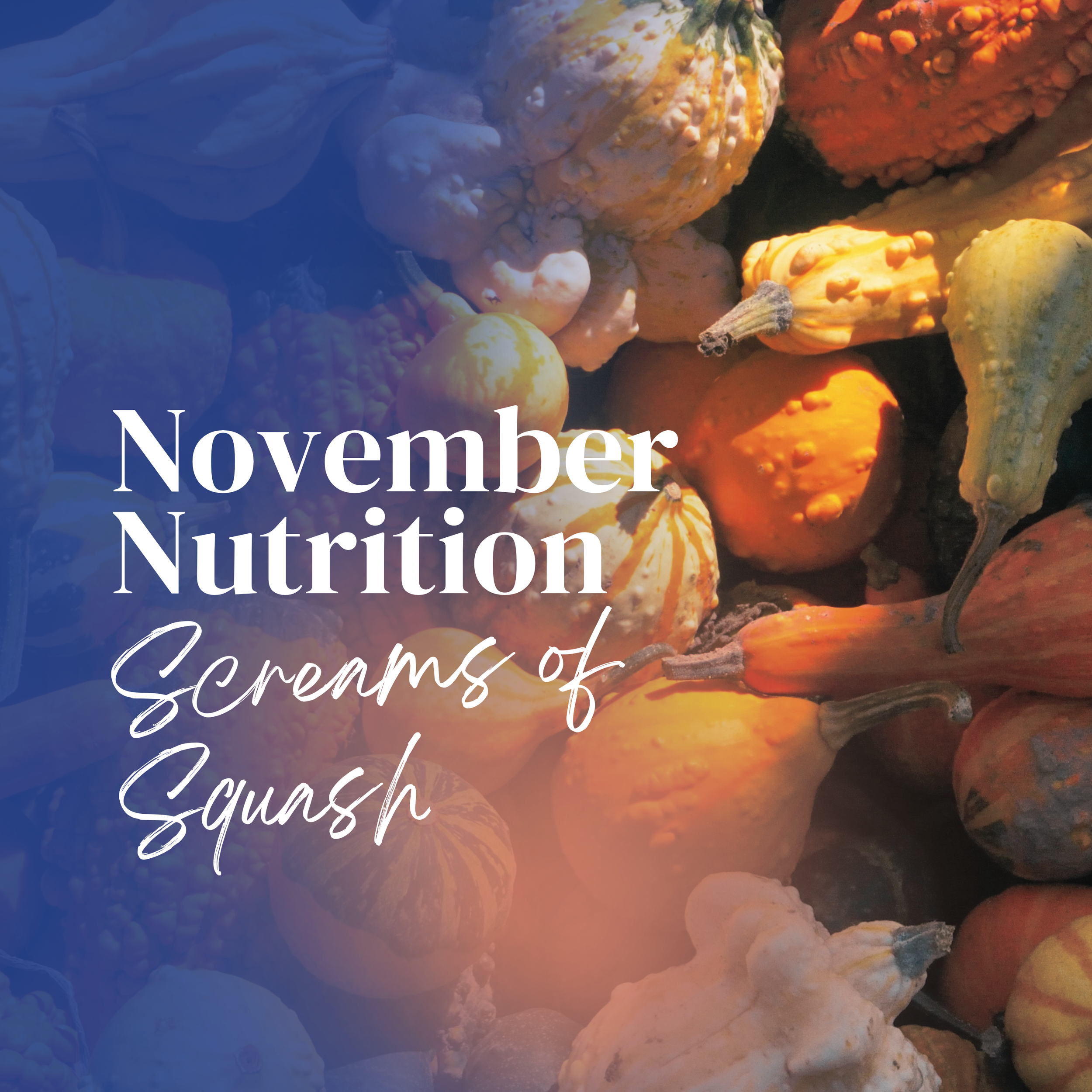
There are a whopping 16 different kinds of winter squash! Red and green kabocha, buttercup, butternut, delicata, sweet dumpling, sugar pumpkin, carnival, red kuri, spaghetti, white acorn, and turban. And the sixteenth, what I thought was a white pumpkin is actually a “hubbard”.
Did you know that squash is also a sport?
This fabulous vegetable, or scary, depending on how you carved your Halloween pumpkin, has differing levels of starch content depending on the season they’re grown. If you had a guess, which season is the starchier?
Cool weather grows the heartier foods, so if you put the winter squash in the starchy category you’d be correct. The summer squash are non-starchy, meaning they have a higher water content and lower carbohydrate content. The way the starchier winter squash interact in our bodies is to break down more slowly, acting like a potato or grain on blood sugar.
Interestingly, spaghetti squash, which true to it’s name often is a pasta replacement in recipes looking to reduce calorie content and increase nutrient density, is right in the middle.
I challenge you to incorporate these gourdgeous vegetables, as they will spice up your family dinner menu and enhance the nutrient density of your meals!
In general, the gourd family is rich in vitamins A, B, and C, fiber, beta-carotene, and tend to provide excellent amounts of potassium, magnesium, manganese, and copper. Pumpkins are wildly rich in beta-carotene, vitamin A, and fiber. Butternut squash is full of vitamin C and A. Acorn squash contains potassium, magnesium, as well as heaps of fiber.
Drop a recipe for us to try in the comments.