I don’t know about you, but when I think about the word “fungi” or “fungal” my mind immediately goes to that foot fungus commercial from the early 2000’s with the little gross toe fungus guys who get under people’s toenails. Perhaps I’m alone in this association, and I certainly hope that’s true, because to minimize the fungi family to a foot fungus would be the same as calling Michael Jordan a “just okay” basketball player.
This species is almost alien in a way with how it grows, what it’s capable of, and how it quietly helps planet earth. Like MJ, it’s actually kind of a G.O.A.T with how incredible it is in our ecosystem.
It can not only boost our immunity as humans but in a process called mycoremeditation, mushrooms have the power to safely and naturally decompose some of the most nastiest forms of human waste, and we’re not talking about your toilet experiences every day, we’re talking plastics, unrefined oil, and even nuclear waste. That is mind blowing.
On top of that, they serve as an underground network of communication lines for trees! Yes! They help trees communicate in an in a way that helps them communally protect themselves against threats.
This article could quickly turn into your next trivia night because there is so much more to mushrooms than meets the eye; alas, in the effort of relevancy and nutrition we’re going to stick with how mushrooms impact you and how valuable they are to your health.
A Round of Trivia Anyone?
We’ll start easy: how do mushrooms grow?
Answer: spores!
Unlike plant seeds that you can see, mushroom spores while seed-like, are microscopic. They thrive in moist, nutrient dense environments.
Well now I’m curious: if they’re microscopic, can you inhale mushroom spores?
The answer is yes; in fact, there’s a condition called Hypersensitivity Pneumonitis aka Mushroom Worker’s Lung. It can cause chronic lung inflammation, though conditions for this to develop are fairly negligent in that the person must be repeatedly inhaling spores in a poorly ventilated environment with many growing mushrooms.
And now I’m afraid: can mushroom spores grow in your lungs?!
No, thank goodness. However, be warned that certain molds are able to do this… yikes.
Next question: are mushrooms a vegetable?
Answer: mushrooms are not a vegetable, though we may commonly think they are because they are grouped with them at the grocery store and prepared in cooking.
As far as categorization goes, they gain another point for alien because they are not an animal or plant product, but belong to their own biological domain: the fungi kingdom.
No judgement if you just imagined the Mushroom Kingdom in Super Mario.
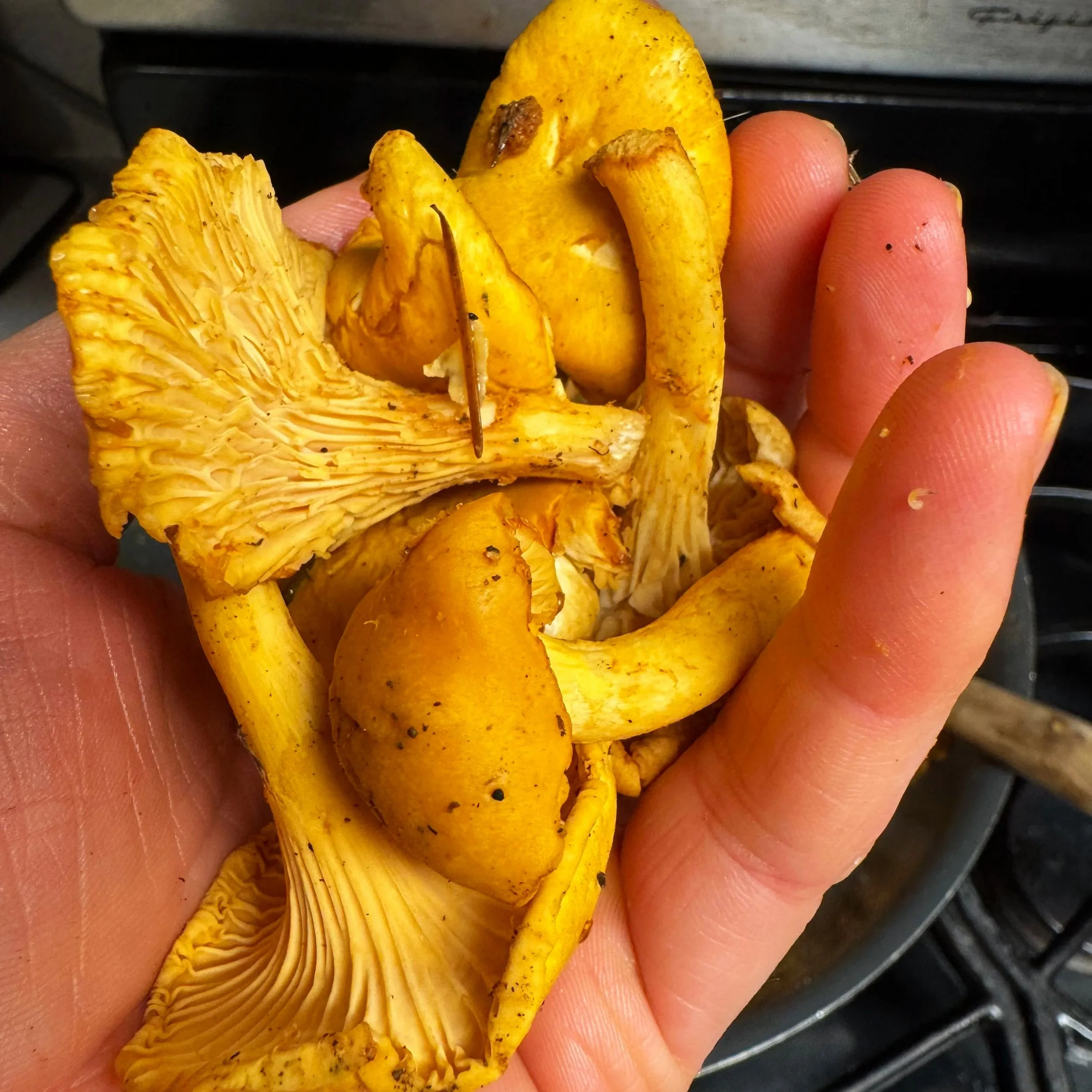
Chanterelle mushrooms
Have you ever thought of: how do mushrooms grow?
The incredible ability of mushrooms to help trees communicate and to recycle our waste? That’s due to the mycelium, the part of the mushroom that is growing completely out of site in a fantastically beautiful web of thread-like filaments similar to a plant’s root system. What we forage above ground or on the outside of the tree would be akin to the mushroom’s fruit.
So back to me, the human: what nutrients are mushrooms uniquely rich in?
Where mushrooms really excel from a nutritional standpoint is that they are the only non-fortified “plant” based food that is rich in Vitamin D. With Vitamin D deficiency estimated to affect 1 billion people worldwide, and specific risk groups including young adults (ages 19 - 44 years), women (17.8% vs. 13.6%), northern latitude living, greater risk in winter (1.7x higher than the rest of the year), and dark skin pigmentation, intentional consumption of Vitamin D should really be treated as a non-negotiable.
What is the dosage of Vitamin D in mushrooms?
Because there are so many types of mushrooms, it’s hard to give an exact answer on this; however, a cup of the common crimini contains an 185% daily dose of Vitamin D and the portabella a generous 165%. The tricky part is that cooking them in oil leeches the Vitamin D by about 40% from the mushroom because vitamin D is fat-soluable. So in those cases you’ll want to use the juices in the pan to make a sauce or broth.
Additonal fun fact about the portabello, it’s actually just a more mature crimini! The button, or white mushrooms we commonly see in the grocery store, are the more immature version of the crimini.
What other nutrients are in our fungi friends?
Mushrooms also contain selenium, a mineral that cannot be produced by the body, and is necessary for protecting cells, proteins, and DNA from oxidative stress.
Selenium is also critical for thyroid health. A cup of shiitake can provide around 65% of an adults daily value, while the more common crimini can provide around 45%.
Finally, and not to be minimized in the value of this by the one sentence summary, mushrooms contain nutrients that support immune function and protect us from oxidative stress.
Translation: oxidative stress accelerates aging, influences chronic inflammation and fatigue, and destroys vital cellular structures like DNA.
Therefore, foods like mushrooms that are rich in antioxidants and defend against that oxidative stress should be hugged and thanked before chopped and consumed.
How many different kinds of mushrooms are there?
If your mind hasn’t been blown yet, this stat may be the one to do it… mycologists (mushroom scientists) approximate that there are a whopping 1.5 to 3 million different species of fungi on earth, though a much smaller percentage, around 14,000, of that have been identified and named as mushrooms.
Final fun fact, mushrooms are grouped in the following types: gilled, pored, toothed, clubbed, coral, gasteroids, jelly, and morels.
And, with that, the morel of this story is that our fun-guy friend is a pretty rad addition to your dinner table, and if nothing else, an amazing and impactful part of our planet.